
Bricks Don’t Burn; on Bricks as Culture

What could a brick mean beyond construction? In this blog, Mitchell van Vuren traces the brick through architecture, property, revolt, and culture, tracing how an ordinary object can carry surprising social, political, and symbolic weight.
What could be the point of discussing bricks? Sure, you find them in houses across much of the world, and many readers will recognise their familiar shape, size, and function. Bricks are part of the basic infrastructure through which human life is materially organised, both collectively and individually. Bricks are property – they are units that make up larger wholes and belong to you, to me, to an institution, to the state, and so on. A brick is never something in itself for the sake of its complete artificiality. In the line of thinking that a leaf, a tree, a river is part of nature and, thus, deserves a kind of rights, a brick is rightless in its being always a manufactured component. Urban centres would be difficult to imagine without bricks and other such building materials, just as forests cannot be imagined without trees. From a distance, one might even say that much of human civilisation is built out of bricks. Would that be such a mistaken impression?
My apologies if the expansion upon bricks that follows looks something like a bricolage. The act of addressing the brick’s perceived invisibility and unveiling it as a brick also feels a bit like a game of Jenga. You feel your way around, pushing one tile a bit and pulling the other. How high can the tower become before it falls into pieces? And if it does collapse, what remains but rubble, a pile of bricks stripped of function and returned to its sole materiality? Speculating about the cultural connotations of bricks might topple the semiotic tower. Or it facilitates the building of another brick house in just the same manner. It all depends on how we come to the final assessment of what modern architecture ought to look like.
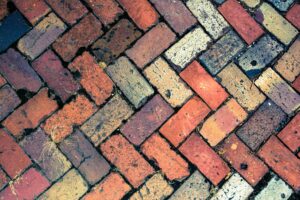
Bricks are handy objects, so to speak. After all, we build with bricks. We take various kinds of soil (mostly clay), mix them, and often bake them to become the desired brick unit. Their composition varies across geographical regions according to the natural resources available. This explains the wide colour palette of bricks that exists around the world, depending on the amounts of lime, iron, and other materials in the soil. In my native tongue, Dutch, the brick is linguistically defined by this transformative act of baking stones into bricks (the Dutch term is baksteen: ‘bake stone’). The search for a brick’s essence cannot find an easy answer in its material or its origins. It is too uniform for that, too common, too much embedded in everyday life to be readily recognised as a form of heritage. When we say ‘brick’ in different tongues, we tend to evoke the same basic form: a moulded unit made from earth and used to fill space in the built environment.
Bricks have their own aesthetics. They are often rustic, old-fashioned, and authentic. They are associated with the houses of workers, the factories they go to, the coffee shops that take over when people leave, searching for new lives. The urban landscape arose through the work of bricklayers. First, these architectonic forms were but abstract plans, a few lines on a piece of paper. Before construction, they remained only projected forms. We used bricks to build them and mortar to make them stay that way. We used paint to cover up the brick’s rough aesthetics and inhabitants to naturalise whatever fanciful came thereafter. Bricks are an undeniable part of modernity’s skeleton, keeping us all safe and sound. As such, modernity did not only lead to the redistribution of land between the city and the country. It also redistributed the soil to concretise the dreams of twentieth-century landscape architects. And for that, we built the mines, the factories, the houses. The deserted mining towns that are scattered around the world are shadows of the promises ideologists made so many decades ago. But those dreams are now forgotten, left behind in history. But bricks from the past do not vanish or fade. Bricks break, bricks pulverise, but bricks don’t burn.
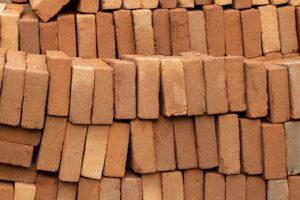
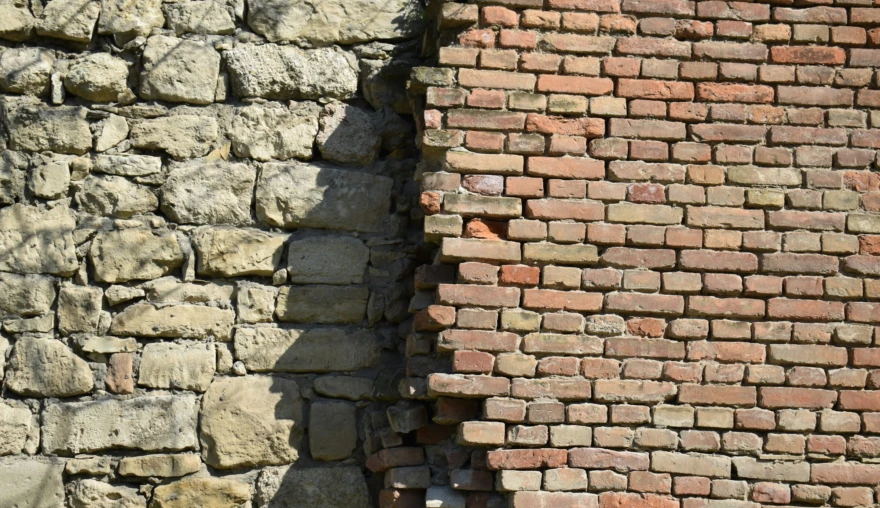
Bricks are not just the world-building tools of the wealthy, busy forging their latest money-making machines. It is the people who are ‘just another brick in the wall,’ as Pink Floyd sang it in their famous song with the same name from 1979. But, as the history of the Berlin Wall shows us, walls are pulled down, taken apart, and claimed for other purposes. When bricks are individualised again, they all of a sudden fit very well into the clenched wrists of angry men. In moments of unrest, hands may hold many things: flags, knives, or bricks. Bricks are usually absorbed into the background of everyday life until moments of damage or destruction make them visible. Then, bricks become the handy things again that we intended them for. A brick can break a window, injure a body, or become part of a larger scene of political rupture. When bricks are uncovered, their structuring purpose falters, and their own fragility is betrayed for all to see. We finally perceive that the wall always has been but a pile of bricks. Why did we not see that before? What habits of perception led us to look through the wall rather than at the materials that compose it? Bricks are not loyal, falling for the ideals of the people in whose hands they end up. The resonance with BRICS, the political acronym, also suggests another imagined world order, presented as an alternative to a declining one. When the first cracks begin to show, the bricks do so too. From that perspective, bricks are perhaps closest to puzzle pieces, discrete parts whose meaning relies on the whole they compose.
Bricks, when mobilised in moments of revolt, can come to signify the destruction of an existing order. This image becomes more complicated when bricks are also understood as forms of property. The two Dutch rappers Kevin and Lijpe sing in the refrain of their rap song Bakstenen (‘bricks’) from the album Verzegeld (2021):
We zijn de hele dag met pap bezig [We’re busy all day with ‘pap’ (paper money or dad, open to interpretation)]
En anders zijn we wel met pap bezig [Otherwise we’re busy with ‘pap’ (paper money or dad, open to interpretation)]
Ik heb m'n papieren hier en daar, maar als ik morgen ga vertrekken [I’ve got my (money) papers here and there, but when I’m leaving tomorrow]
Dan moet iedereen het afgeven [Everybody has to hand them in]
Ik kon het gooien op iets doms weer [I can throw it away on something stupid again]
Maar gooi het liever nu in bakstenen [But I’m rather throwing it into bricks]
Unfortunately, Dutch is not our lingua franca, as the wordplay of Lijpe and Kevin is lost in translation when they come to bricks. When rapping about what to do with their money, they would rather not throw it away on something stupid. What they rather do: “… [ik] gooi het liever nu in bakstenen.” Rather ‘throwing’ their money into bricks or spending it to buy a house, they hint at the saturated Dutch housing market and the present high profitability of investing in real estate. Now that they finally have the cash they chased, they do not ‘throw’ bricks any longer. Having ascended the societal ladder to the wealthy class, they now throw their money ‘into’ bricks. Having turned from vandals into faux riches, Lijpe and Kevin play around with the multiple cultural connotations of bricks and leave their rebellious adolescence behind to finally enjoy the elitist function of bricks as lucrative piggy banks.
If we take bricks as the invisible atoms of our built environment, simultaneously holding the secret power of nuclear change, bricks can act as useful stand-ins for cultural units. Culture is extremely hard to divide, to quantify, to measure. Taking the brick as a metaphor for it transposes these issues to a new context: is one brick one word, or one letter, or one sound, or one thought? What makes bricks so suitable as an analogy is that bricks are never something by themselves. Only when seen relatively, let’s say as part of an apartment block, the Great Wall, the workshop-turned-hipster-joint, do both bricks and cultural units become functional. As we use form to domesticate mass, bricks and cultural forms act as spiritual siblings in their capacity to bring order to the chaos. With culture being the sticky stuff that we need for mediation between lifeforms, bricks are baked by us from the soil we come from and layered upon one another to reach the sky. And just as the tower of Babel was toppled by the sprouting of difference, so does culture rise and fall under the relentless force of differentiation.
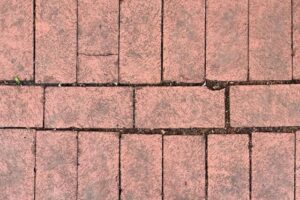
To think of bricks as figures for culture is to think in terms of building, breaking, and crumbling. We use bricks for various purposes: to build our dreams, destroy those of others, or traverse between the different dreams of different classes. We keep on following the Yellow Brick Road (marvelled at in the Technicolour musical The Wizard of Oz (1939)), hoping to find our own destiny at its end. Bricks are part of culture, just as culture resembles bricks to a surprisingly great extent. Culture as bricks stresses how culture materialises, divides, and dissolves. Culture, just as bricks, doesn’t burn. It returns to the ungraspable cultural mass it came from, waiting to be moulded again. And as long as we remain here, we continue to imagine, assemble, and rebuild.
References:
Kevin and Lijpe. 2021. "Bakstenen." Video, 3:07. YouTube video, uploaded October 22, 2021, by TopNotch. https://www.youtube.com/watch?....
© Mitchell van Vuren and Leiden Arts in Society Blog, 2026. Unauthorised use and/or duplication of this material without express and written permission from this site’s author and/or owner is strictly prohibited. Excerpts and links may be used, provided that full and clear credit is given to Mitchell van Vuren and Leiden Arts in Society Blog with appropriate and specific direction to the original content.



0 Comments