
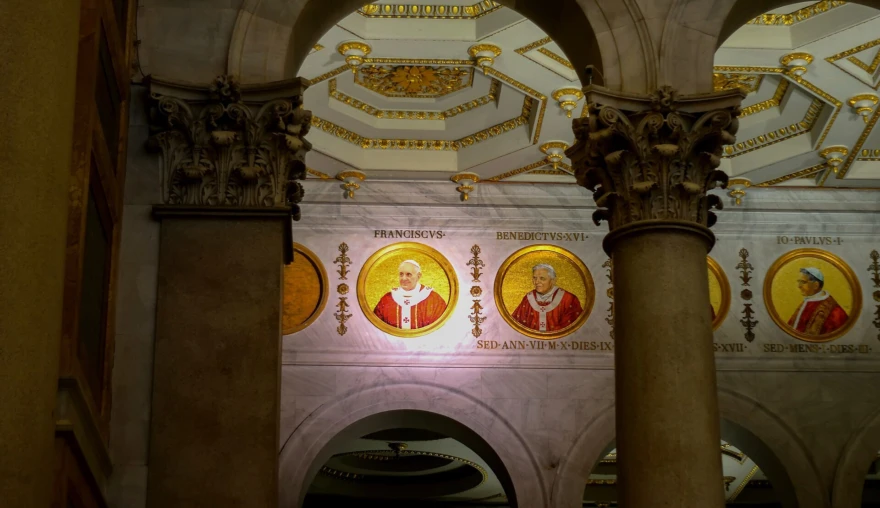
The End in 112 Steps: Counting Down the Popes

The world was supposed to end after the 112th pope. Following Pope Francis’ death, an obscure prophecy attributed to Saint Malachy went viral once again. This post explores the prophecy’s origins, examines why scholars reject its authenticity, and asks why apocalyptic countdowns remain compelling.
The Prophecy of the Popes and the Persistent Allure of the Apocalypse
“But about that day or hour no one knows” (Matthew 24:36). This warning against predicting the second coming of Christ in the Gospel of Matthew is one of the most prominent biblical statements on the unknowability of the end. And yet, history suggests that this has done little to discourage attempts to calculate it. On the contrary, the desire to pinpoint the exact timing of the apocalypse, whether through calendars, calculations or prophetic visions, has proven remarkably persistent.
In recent years, following the death of Pope Francis in April of 2025, the so-called Prophecy of the Popes, allegedly written in the 12th
century by the Irish archbishop Saint Malachy, gained renewed interest. According to this prophecy, the succession of popes would culminate in a final figure, referred to as Petrus Romanus (“Peter the Roman”), whose pontificate would herald the destruction of Rome and the Last Judgment. If the sequence of 112 popes is to be believed, that final chapter may be closer than expected, or perhaps already behind us.
In persecutione extrema S.R.E. sedebit Petrus Romanus, qui pascet oves in multis tribulationibus: quibus transactis, civitas septicollis diruetur, et Iudex tremendus iudicabit populum suum. Finis.
“During the final persecution of the Holy Roman Church, Peter the Roman shall reign, who will pasture his sheep among many tribulations; when these things are finished, the city of seven hills will be destroyed, and the dreadful Judge will judge his people. The end.”
Whether or not the prophecy is genuine, however, is only part of the story. The enduring fascination with the Prophecy of the Popes raises a broader question: why are people repeatedly drawn to predictions claiming to reveal the timing of the end? This blog first examines the origins and historical credibility of the prophecy before turning to its modern revival. In doing so, it explores why apocalyptic countdowns remain so compelling, even when their predictions repeatedly fail to materialize.
Medieval Prophecy or Renaissance Invention?
The Prophetia Sancti Malachiae Archiespiscopi de Summis Pontificibus (“Prophecy of Saint-Archbishop Malachy concerning the Supreme Pontiffs”) consists of 112 short and cryptic Latin phrases, each supposedly describing a future pope (as well as some antipopes) of the Catholic Church. The list begins with Celestine II (r. 1143–1144) and concludes with the enigmatic Petrus Romanus. Despite its medieval attribution, the prophecy was first published in 1595 by the Benedictine monk Arnold de Wion. He claimed to have discovered it in a manuscript attributed to Saint Malachy, the 12th-century Archbishop of Armagh in Ireland, who allegedly experienced a prophetic vision during a visit to Rome under Pope Innocent II. Subsequently, the manuscript containing his cryptic prophecy was said to have remained forgotten, hidden away in the Vatican Secret Archives until its rediscovery in 1590.
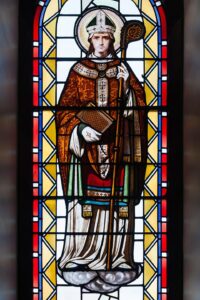
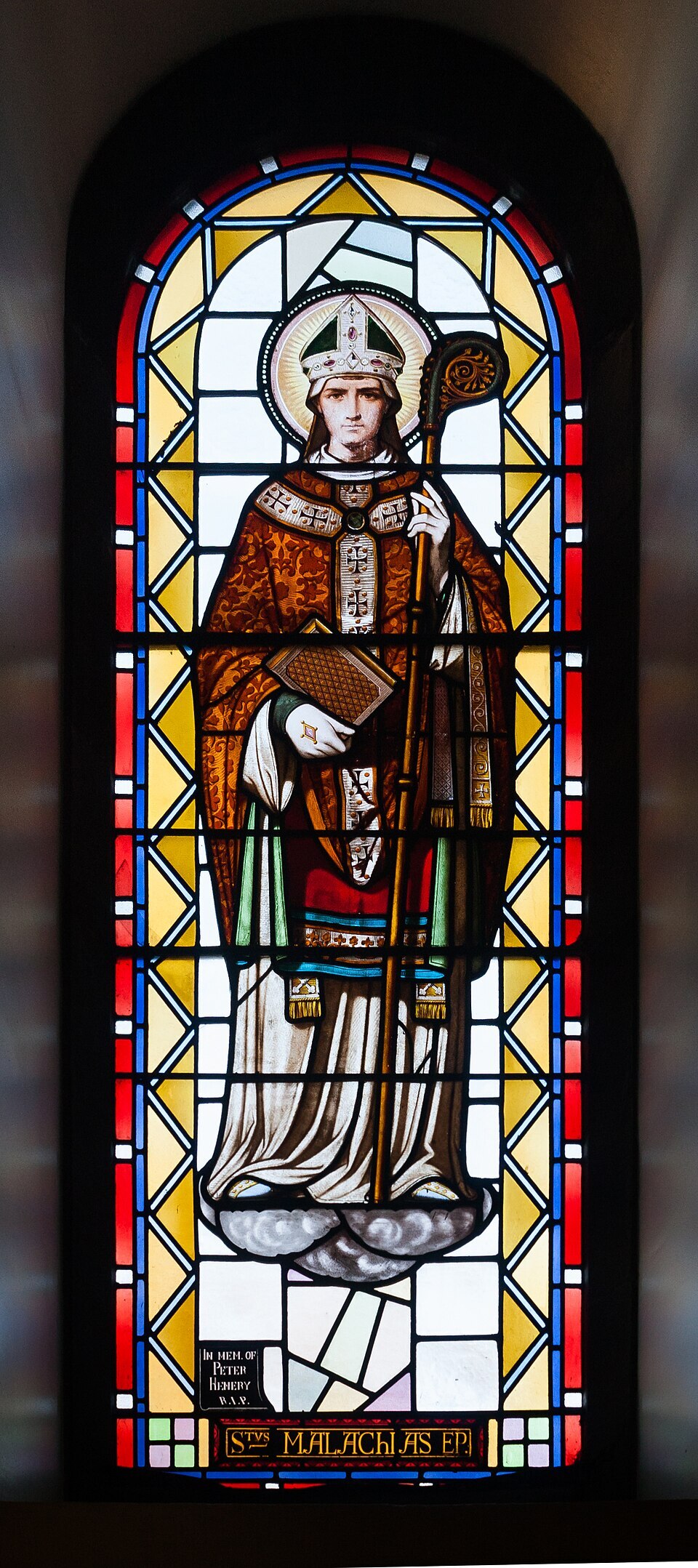
Suspicions were raised when historians noticed the striking accuracy of the predictions up to the late 16th century, followed by a marked decline in precision. Early entries neatly align with papal origins, coats of arms, names or epithets. Examples include the first pope in the list, Celestine II, whose description reads ex castro Tiberis (“from a castle of the Tiber”). He was born in Città di Castello on the banks of the Tiber. Similarly, Pope Urban III (r. 1185–1187) received the motto sus in cribro (“pig in a sieve”). His family name, Crivelli, is derived from a word meaning ‘sieve’ in Italian (‘crivello’), and his familial crest bore a pig.
In contrast, predictions after around 1590 become vague and open-ended, often showing inaccuracies. For example, pope 95, equated with Pope Clement XIV (r. 1769–1774), is called ursus velox (“swift bear”). Although believers in the prophecy have claimed without any evidence that his papal arms feature a running bear, no connection to this description can be found in either Clement’s name, origins or arms. This pattern led to the recognition of the text as a vaticinium ex eventu (“prophecy from the event”). In other words, the earlier ‘predictions’ seem to have been constructed retrospectively at the end of the 16th century, giving the illusion of foresight. This explains why the later predictions are much more inaccurate. This hypothesis is reinforced by the fact that St. Malachy’s friend and biographer, St. Bernard of Clairvaux, makes no mention of the prophecy, while writing extensively about the miracles St. Malachy performed.
Some have proposed a strategic origin for the document. Conveniently, the rediscovery of the manuscript containing the prophecy coincided with the upcoming papal conclave following the death of Pope Urban VII in 1590. The prophecy may have functioned as a piece of political propaganda during the conclave, supporting the candidacy of Cardinal Girolamo Simoncelli. The motto ex antiquitate urbis (“from the antiquity of the city”), could be read as a reference to Orvieto (Urbevetanum, meaning “old city”), Simoncelli’s birthplace. Although this theory remains debated, it illustrates how prophetic texts may have served immediate historical interests.
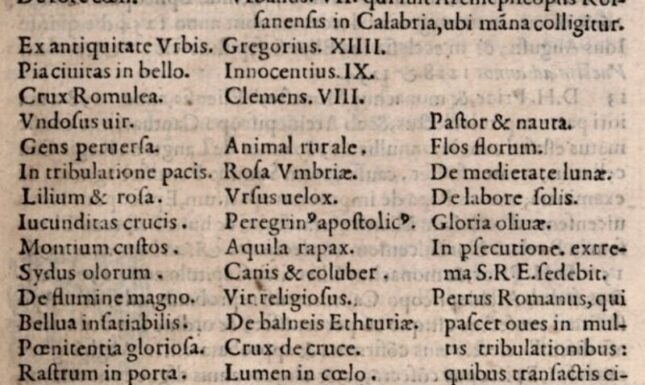
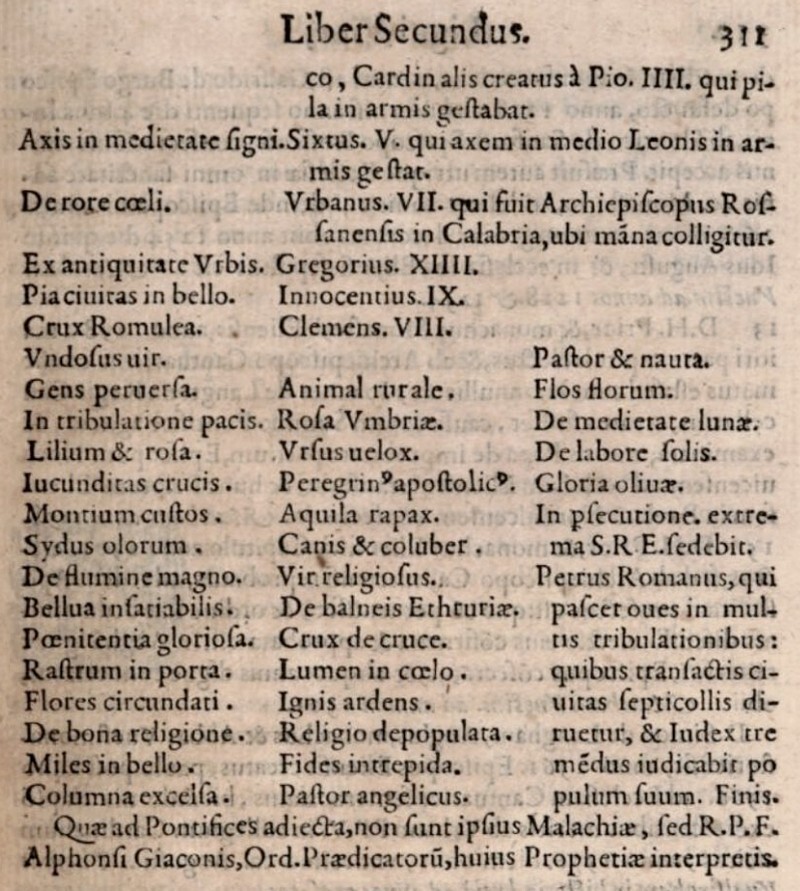
Surprisingly, however, a few of the later predictions are uncannily appropriate: lumen in caelo (“light in the sky”) very accurately corresponds to its assigned pope in the list, Leo XIII (r. 1878–1903), whose coat of arms features a falling star. However, such correspondences are not necessarily evidence of prophetic accuracy. Rather, they illustrate what psychologists call the ‘Jeane Dixon effect’, which refers to the tendency to remember a few striking correct predictions while overlooking the many less convincing or failed ones. Given the ambiguity of most of the phrases, a few shots out of the 112 are bound to land. The continued attraction of the Prophecy of the Popes therefore tells us less about its predictive power than about our persistent desire to render intelligible the uncertain future.
Post-Apocalyptic Blues
In recent years, the prophecy experienced a resurgence. According to interpreters aligning the entries with modern popes, the fated coming of Petrus Romanus was (or is) imminent. Benedict XVI (r. 2005–2013), gloria olivae (“glory of the olive”), was the penultimate 111th pope. His resignation, an exceedingly rare event, only heightened the sense of historical significance. Speculation flourished on online forums and media outlets about his successor, Pope Francis, drawing connections between him and his namesake, the Italian St. Francis of Assisi, whose father was called Pietro. Was Francis the fated Petrus Romanus? To the dismay of believers, Pope Francis died in 2025, and the expected end did not arrive. Leo XIV was elected pope, and Rome still stands. To most, St. Malachy’s prophecy has turned out to be little more than malarkey, but some have placed their hope in recalculations. One interpreter, Hermann Hiery, has proposed revisions of the list, leaving room for two additional pontiffs after Leo XIV. The countdown, it seems, can always be recalibrated when crisis is averted.
For the Love of Lists
The Prophecy of the Popes exemplifies a broader feature of apocalyptic thinking: the appeal of lists. Enumerations of rulers, years or cosmic events appear across cultures and traditions, from the Book of Daniel to the Mayan calendar. Such lists and calculations impose structure on uncertainty. They suggest that history is not open-ended, but finite and measurable. With each new pope, the world is one step closer to the end, an idea that is at once unsettling and strangely reassuring. If the end can be counted, it can also be anticipated. So, what do we do when the end fails to materialize? We conclude that our predictions must have been wrong and try again.
This blog is the first in a three-part series on apocalyptic thinking in the arts, written by MA-students as part of the course "Apocalypse Now!? End-Time Scenarios in Ancient, Jewish and Early Christian Literature and Beyond". Together, the three posts explore how apocalyptic thinking shapes artistic practices and cultural debates from different disciplinary perspectives.
Further reading
Allan, T. Prophecies: 4,000 Years of Prophets, Visionaries and Predictions. London, 2009.
Bander, P. The Prophecies of St. Malachy, Buckinghamshire, 1969.
Campbell, P. “Prophecies of Malachy: Case for Authenticity.” February 1, 2013. https://unamsanctamcatholicam.....
Gryboski, M. “Did a Medieval Saint Wrongly Predict the Number of Popes Before the End Times?” May 15, 2025. https://www.christianpost.com/....
Lago, J.M. “Does Pope Benedict XVI’s Resignation Signal the ‘End Times’?” February 15, 2013. https://www.gmanetwork.com/news/topstories/specialreports/295099/does-pope-benedict-xvi-s-resignation-signal-the-end-times/story/.
Melore, Chris. “Thousand-year-old prophecy predicts next Pope after Francis dies... and issues a chilling warning for humanity” April 21 2025. https://www.dailymail.com/scie...;
O’Brien, M.J. An Historical and Critical Account of the So-called Prophecy of St. Malachy Regarding the Succession of Popes. Dublin, 1880.
Santucci, J. “The Last Pope? An Ominous Ancient Prophecy Resurfaces After Pope Francis’ Death.” May 8, 2025. https://eu.usatoday.com/story/....
Sieczkowski, C. “St. Malachy Last Pope Prophecy: What Theologians Think About 12th-Century Prediction.” February 14, 2013. https://www.huffpost.com/entry....
© Dante Aramideh and Leiden Arts in Society Blog, 2026. Unauthorised use and/or duplication of this material without express and written permission from this site’s author and/or owner is strictly prohibited. Excerpts and links may be used, provided that full and clear credit is given to Dante Aramideh and Leiden Arts in Society Blog with appropriate and specific direction to the original content.



0 Comments