
Prophets with Guitars: How Folk Music Gave Voice to the Modern Apocalypse

What if the apocalypse had a soundtrack? Woody Guthrie and Bob Dylan used folk music to turn revelation into protest and the end of the world into hope for a world remade. In their songs, the apocalypse is still alive: not in the form of a religious worldview, but in songs that imagine a new future.
When we hear the word apocalypse, we often imagine angels, cosmic battles, and the destruction of the world. Yet the Greek apokalypsis means “to disclose” or “to unveil” (Collins, 2014), that is, the exposure of a hidden truth. In this sense, apocalypticism is less a fixed literary genre than a worldview, in which reality is shaped by hidden forces, the present world is fundamentally disordered, and an imminent transformation will resolve this tension (Crossley, 2024). What distinguishes apocalyptic thinking from protest or prophecy is its combination of cosmic scope, hidden revelation, and imminent moral reversal. Thus, apocalyptic thinking is not limited to religious texts such as Daniel or Revelation, but also appears in ancient authors like Ovid or Vergil (Star, 2021), and in modern culture, including mid-twentieth-century US folk music. Here I will focus on the songs of Woody Guthrie and Bob Dylan. Written amid the Cold War and civil-rights movement, these songs, I argue, adopt precisely these apocalyptic markers: they expand social crisis to a near-cosmic scale, unveil hidden injustice, and imagine the imminent moral overturning of an unjust order.
Guthrie’s song This Land Is Your Land is a clear example. At first glance, the lyrics seem like a patriotic celebration of the US’s landscape. Yet the opening lines create something larger than a national song. Guthrie sings: From California to the New York Island / From the Redwood Forest to the Gulf Stream waters. The nation becomes an almost cosmic landscape, resembling ancient apocalypses, where the visionary sees the world from above. Guthrie repeatedly describes what he saw: an endless skyway, a golden valley, the sweeping land below him. In biblical apocalyptic texts, the seer often declares “And I saw…”. Seeing becomes revelation, a way of grasping the world’s reality.
Guthrie’s revelation arrives unexpectedly: a voice was chanting as the fog was lifting. The lifting fog suggests the removal of ignorance, while the voice proclaims the hidden moral truth: This land was made for you and me. In classical apocalyptic narratives, revelation often comes through divine or angelic voices. In Guthrie’s song, the voice is not supernatural but functions similarly: secularly revealing a moral truth society has forgotten. The most dramatic moment of unveiling occurs when the singer describes: There was a big high wall there that tried to stop me / Sign was painted, said, ‘Private Property.’ The sign represents legal order. However, the narrator notices: But on the back side, it didn’t say nothing. The sign’s authority collapses. What appeared legitimate is exposed as artificial. Like ancient apocalyptic texts exposing corrupt empires, the song reveals that the existing social order rests on an illusion (Friesen, 2014). Thus, Guthrie’s song performs a form of secular apocalyptic critique. It exposes the gap between US ideals and social reality, while the chorus imagines shared belonging and justice. The world appears unjust, yet the revelation carries hope.

If Guthrie unveils hidden injustice, Bob Dylan’s work pushes apocalyptic imagination toward catastrophe. Dylan’s A Hard Rain’s A-Gonna Fall resembles end-of-times literature. The song unfolds as a sequence of visionary reports: Oh, what did you see, my blue-eyed son? The answer offers surreal images: dead oceans, bleeding branches, and children holding weapons. These are not literal predictions. Apocalyptic texts often depict reality through mythic symbolism: monsters, cosmic disturbances, and unnatural landscapes. Dylan’s visions follow the same pattern. The phrase a newborn baby with wild wolves all around evokes a world where innocence is threatened by violence, while a highway of diamonds with nobody on it suggests wealth without moral purpose or community. At the center of the song lies the repeated warning: It’s a hard rain’s a-gonna fall. Written during the Cold War, the song reflects the nuclear anxieties of an era when global destruction seemed terrifyingly possible. Yet the “hard rain” also echoes apocalyptic narratives, as in Seneca, where destruction reveals moral failure and prepares renewal.
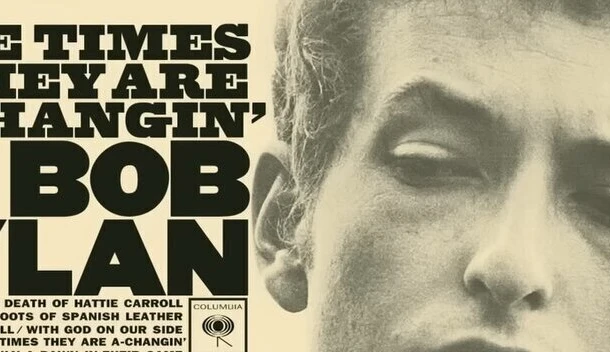
Similarly, Dylan’s The Times They Are A-Changin’ expresses apocalyptic logic more collectively. The song issues a public summons: Come gather ’round people; Come writers and critics; Come senators, congressmen / please hear the call; Come mothers and fathers. This gives the song the tone of prophetic address: it commands its audience to recognize change and respond before it is too late. The warning is explicit: admit that the waters / around you have grown, or soon you’ll be drenched to the bone. Like older apocalyptic texts, the song presents crisis as underway and divides its audience according to their ability to read the signs of the time. It also stages moral reversal in For the loser now / will later to win, and the first one now / will later be last (reference to Mk. 10:31 and Matt. 20:16). As Bart Ehrman (1999) notes, early apocalyptic movements often imagined a coming reversal in which the powerful are brought low and the marginalized vindicated. Dylan translates that pattern into a modern, secular key. The old order is rapidly fadin’, and those who cling to it are told to move aside: Please get out of the new one / if you can’t lend your hand. The song’s power lies in framing the present as a decisive moment in history, when the old order collapses and a new one begins to emerge: for the times they are a-changin’.
Taken together, Guthrie and Dylan show that apocalyptic thinking extends far beyond explicitly religious texts. Their songs use revelation, vision, and moral judgment to expose injustice and imagine a different future. As scholars have shown, US culture has long used apocalyptic language to interpret uncertainty and upheaval (Wojcik, 1997), and folk music offers a vivid example. Instead of angels revealing divine secrets, the prophet may be a wandering singer; instead of a heavenly kingdom, the promised future may be a more just society.[1] So, if we ever ask ourselves, “What does the apocalypse sound like?” we might do well to listen to these prophets with guitars. For apocalypse is not only the end of the world: it is the unveiling of a world that must change, and the stubborn hope that “from the depths of time, another time will come” (Zitarrosa, 1973).
[1] This pattern also appears in Dylan’s When the Ship Comes In and It’s Alright, Ma (I’m Only Bleeding), Guthrie’s Better World A Comin’, and Pete Seeger’s Banks of Marble and Last Night I Had The Strangest Dream, where ecological disaster, class inequality, prophecy, and hopes for a better world become forms of apocalyptic revelation.
This blog is the second in a three-part series on apocalyptic thinking in the arts, written by MA-students as part of the course "Apocalypse Now!? End-Time Scenarios in Ancient, Jewish and Early Christian Literature and Beyond". Together, the three posts explore how apocalyptic thinking shapes artistic practices and cultural debates from different disciplinary perspectives.
Songs and Bibliography
Songs
Dylan, B. 1963. “A Hard Rain’s A-Gonna Fall,” in The Freewheelin’ Bob Dylan, Columbia Records.
Dylan, B. 1964. “The Times They Are A-Changin’,” in The Times They Are A-Changin’, Columbia Records.
Dylan, B. 1964. “When The Ship Comes In,” in The Times They Are A-Changin’, Columbia Records.
Dylan, B. 1965. “It’s Alright, Ma (I’m Only Bleeding),” in Bringing It All Back Home, Columbia Records.
Guthrie, W. 1997 [orig. 1944]. “This Land Is Your Land,” in This Land Is My Land: The Asch Recordings, Vol. 1, Folkways Records.
Guthrie, W. 1998 [orig. 1946]. “Better World A Comin’,” in Hard Travelin’, The Asch Recordings, Vol. 3, Folkways Records.
Seeger, P. 1956. “Last Night I Had The Strangest Dream,” in Love Songs For Friends & Foes, Smithsonian Folkways Recordings
Seeger, P. 1958. “Banks of Marble,” in Gazette with Pete Seeger, Folkways Records.
Zitarrosa, A. 1973. “Adagio en mi país”, in Adagio en mi país, Sondor.
Further reading
Boyer, P. 1992. When Time Shall Be No More: Prophecy Belief in Modern American Culture, Cambridge, MA.
Collins, J.J. 2014. ‘What Is Apocalyptic Literature?’, in J. J. Collins (ed.), The Oxford Handbook of Apocalyptic Literature, Oxford.
Crossley, J. 2024. ‘Apocalypticism and Millenarianism’, in J. Crossley and C. Keith (eds.), The Next Quest for the Historical Jesus, Grand Rapids.
DiTommaso, L. 2014. ‘Apocalypticism and Popular Culture’, in J. J. Collins (ed.), The Oxford Handbook of Apocalyptic Literature, Oxford.
Ehrman, B.D. 1999. Jesus: Apocalyptic Prophet of the New Millennium, Oxford.
Friesen, S.J. 2014. ‘Apocalypse and Empire’, in J. J. Collins (ed.), The Oxford Handbook of Apocalyptic Literature, Oxford.
Star, C. 2021. Apocalypse and Golden Age: The End of the World in Greek and Roman Thought, Baltimore.
Wojcik, D. 1997. The End of the World as We Know It: Faith, Fatalism, and Apocalypse in America, New York.
© Santiago García Sosa and Leiden Arts in Society Blog, 2026. Unauthorised use and/or duplication of this material without express and written permission from this site’s author and/or owner is strictly prohibited. Excerpts and links may be used, provided that full and clear credit is given to Santiago García Sosa and Leiden Arts in Society Blog with appropriate and specific direction to the original content.






0 Comments